
INNOVATION & VERIFICATION BRIEF | PATENT PENDING
World-First S-Hinge Clamped Pipe Support Shoe
A joint venture between Pipe Support Verification AS and Torgy Group has now resulted in this new pipe support clamp/shoe.
Extensive work with design, fabrication, and testing verified the “fit for purpose” and is now ready to be introduced to the market.
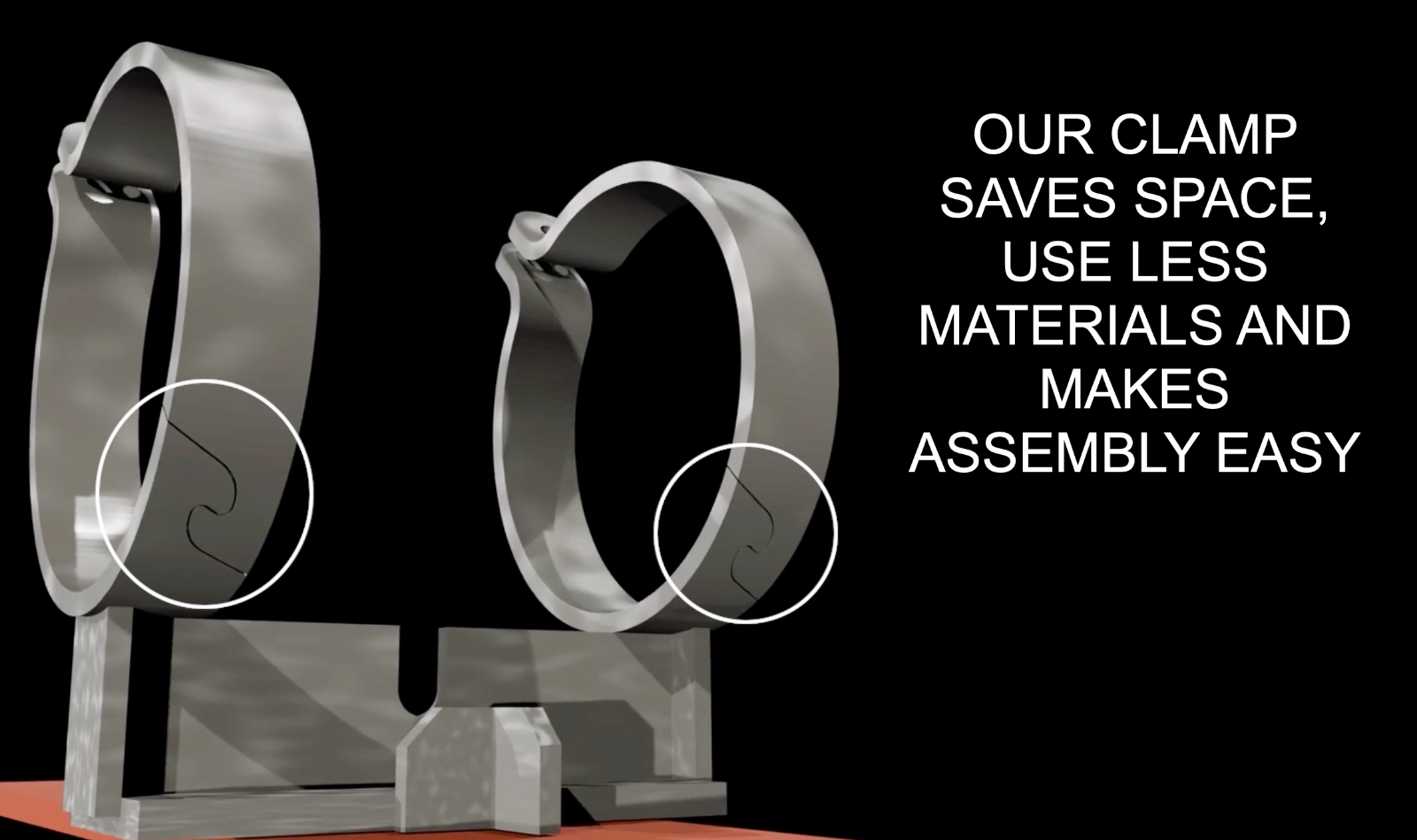
1 BOLT
CLAMP
INSULATION
FRIENDLY
NO GUIDE
CONFLICT
PIPE-RACK
EFFICIENT
A compact, insulation-friendly alternative to the traditional two-bolt clamped shoe – verified through destructive clamp testing and line-guide / line-stop strength testing.
1. The invention: the S-hinge
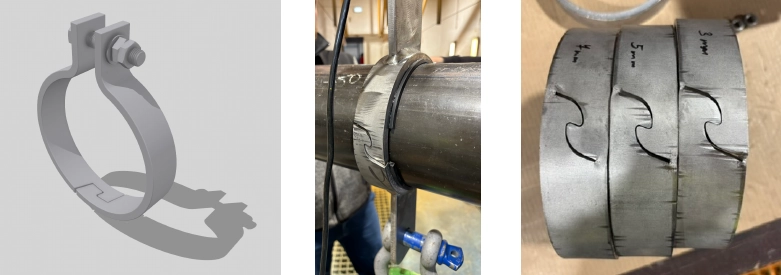
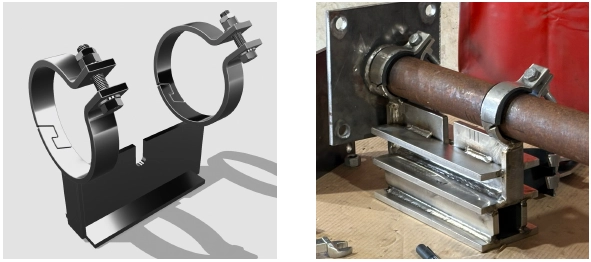
The key invention is the patent-pending S-hinge: A new interlocking connection between the two clamp halves. Instead of closing the clamp with two conventional bolted joints, one side is joined by the S-shaped hinge, and only one fastening bolt is required on the opposite side.
The S-hinge creates locking in all in-plane directions, which secures that the clamp cannot disconnect just by overcoming friction loads.
Why it is different
Fewer bolted joints:
– one fastening bolt rather than the traditional two-bolt arrangement.
Pipe-insulation friendly geometry:
– easier access for insulation work and less occupied volume around the pipe support.
Compact support envelope:
– pipes can be routed closer together than with a traditional clamped shoe arrangement.
Guide compatibility:
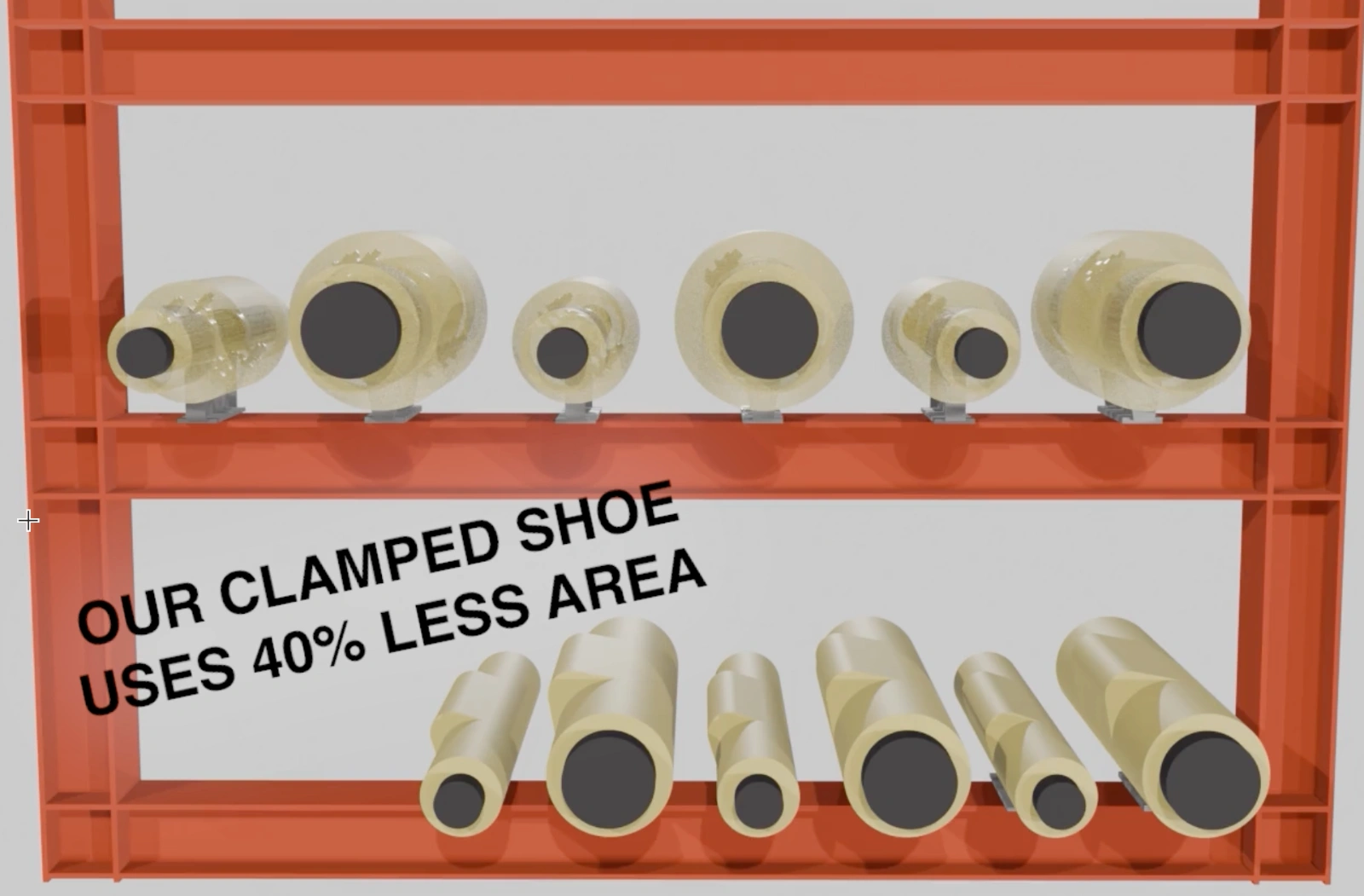
– the compact shoe geometry avoids conflict between the clamp/shoe and line guides, including the illustrated 100 mm high shoe.
Pipe-rack efficiency:
– design studies supplied with the invention indicate that pipe-rack tier area can be reduced by up to 40% in suitable layouts.
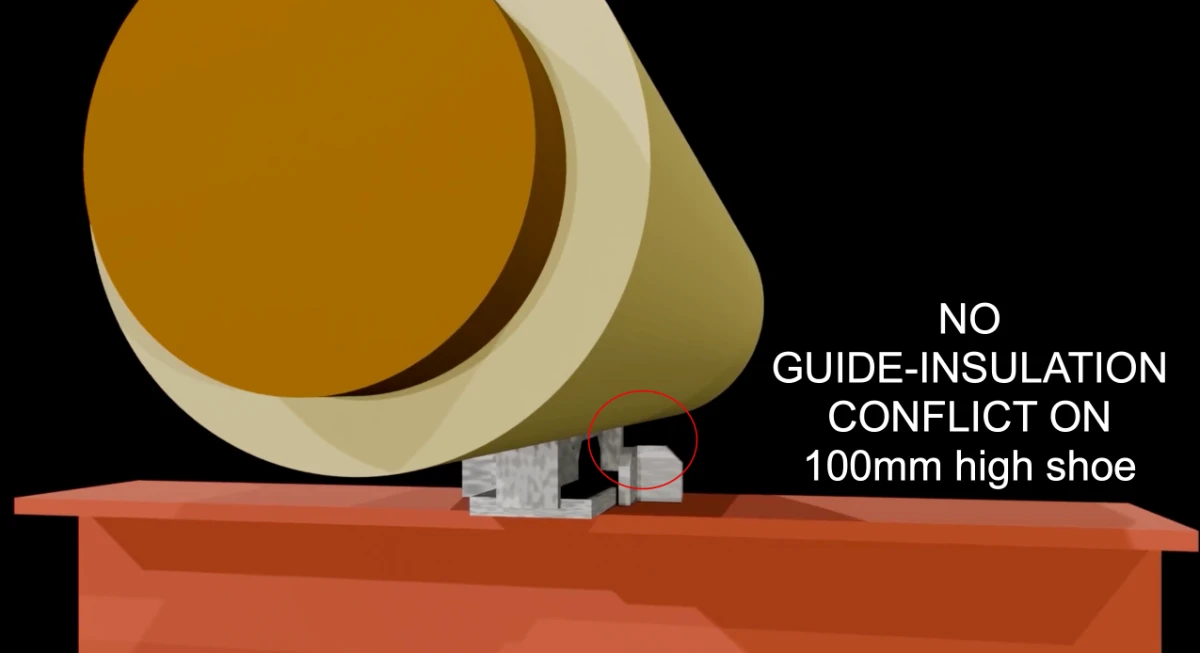
No line-guide/insulation conflict on the 100 mm shoe concept
Compact rack arrangement illustrating the claimed space-saving potential.
2. Verification program
The test program was designed to answer a simple engineering question: can the new S-hinge concept provide the practical advantages above without sacrificing the strength expected from a traditional clamped pipe support shoe?
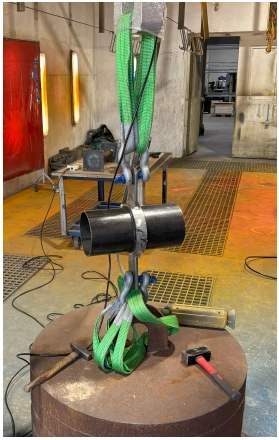
Representative sizes and materials.
Testing used DN50 and DN150 S-hinged clamps/shoes. The report states lean duplex steel (EDX 2304), ASEplas SW150 clamp lining and A4-80 bolts. A traditional two-bolt clamped shoe was tested as the reference configuration.
| Test element | Purpose |
|---|---|
| Destructive S-hinge clamp test | Establish the load level at which yielding/movement of the hinge becomes visible. |
| Circumferential load (line guide) | Determine resistance to sideways rotation/movement around the pipe for 100 mm and 150 mm shoe heights. |
| Longitudinal load (line stop) | Determine resistance to sliding along the pipe and compare the S-hinged shoe with a traditional two-bolt shoe. |
3. Results and engineering conclusion
VERIFIED OUTCOME: FIT FOR PURPOSE
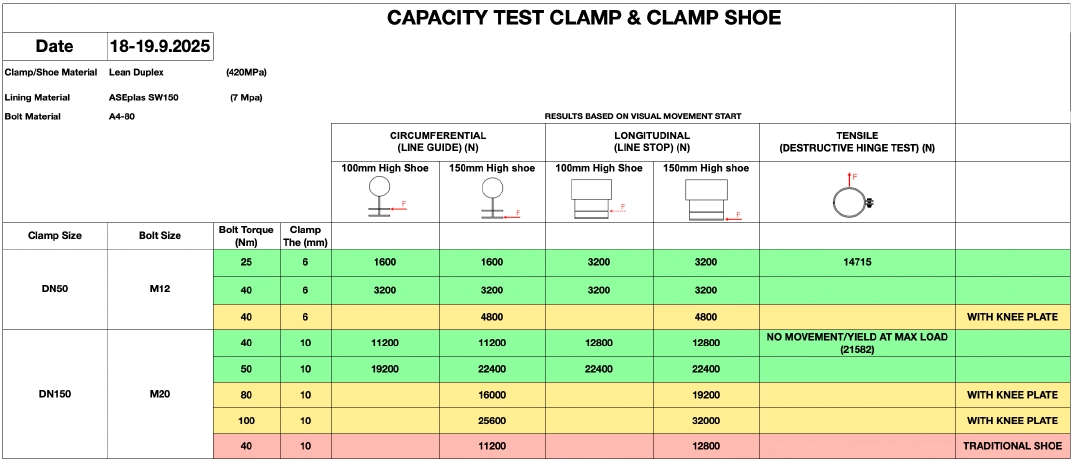
The source report concludes that the S-hinged design is as strong as the traditional two-bolt clamp/shoe and can replace the traditional design using the same allowable loads, subject to appropriate engineering safety factors.
Key observations from the reported testing:
- DN50 S-hinge destructive testing recorded 14.7 kN in the report table.
- For DN150, the report table notes no movement/yield at the maximum applied destructive-test load of 21.6 kN.
- The traditional two-bolt clamped shoe was tested in the same manner for comparison; the report concludes that the new S-hinged design is strength-wise equivalent to the traditional arrangement.
- The report recommends conservative allowable loads and a robust safety factor because movement was judged visually and lining response can vary.
What the invention changes
- One bolt + S-hinge closure
- Better insulation access
- No line-guide conflict
- Up to 40% rack-tier area reduction
What the testing verifies
- Hinge destructive strength
- Line-guide resistance
- Line-stop resistance
- Comparable traditional-shoe strength
Bottom line
The patent-pending S-hinge combines a smaller, simpler and more insulation-friendly clamped shoe with verified load performance comparable to the conventional two-bolt design. The result is a support concept that can simplify fabrication and installation while enabling more compact pipe-rack layouts.